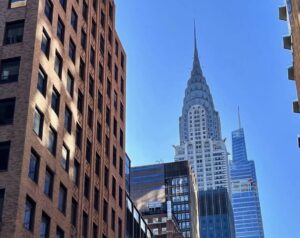
Few New York colleges can say their finances rest on an Art Deco icon. For the Cooper Union, that has been true for more than a century, and a new agreement over the Chrysler Building may now help the school reach one of its biggest ambitions: making undergraduate education free again for every student.
The private college, founded in 1859 by inventor and businessman Peter Cooper, has owned the plot at Lexington Avenue and 42nd Street since 1902, when Cooper’s heirs gave it to the school. It has now handed the lease on the tower to Tishman Speyer, one of the city’s best known property firms. In return, the developer will pay the college rent for the land, and school leaders say that income will go toward restoring full scholarships for all undergraduates. President Steven McLaughlin framed the deal as an investment in students who have not even enrolled yet.
A $235 million facelift
For the building itself, the deal brings its most significant refresh in years. Tishman Speyer and its partners have committed $235 million to the work.
The most visible change will be at the top. The stainless steel crown, with its stacked sunburst arches, is due to be cleaned and repaired, and crews will also restore the exterior along all 77 floors. Higher up, the 61st floor will be reimagined as an exclusive lounge, giving visitors a close view of the giant steel eagles perched at its corners.
Inside, the upgrades are more practical: modern elevators, new wiring and fresh heating, cooling and ventilation systems.
Betting on Midtown offices
The developer sees a clear business case. Office space near Grand Central is hard to find, and the area has seen little new construction in a generation. Tishman Speyer plans to fill most of the tower with offices and to fit out many of them before tenants sign, so companies can move in without waiting through lengthy build outs.
Built in the race for the sky
The tower is a relic of the late 1920s, when New York builders competed fiercely for height. Funded by automaker Walter Chrysler and designed by William Van Alen, it rose between 1928 and 1930 and reached 1,046 feet, briefly making it the tallest structure on Earth. Within a year, the Empire State Building claimed that title.
Van Alen filled the design with nods to his client’s cars. The famous eagles, for instance, borrow their look from the hood ornaments on 1929 Chrysler vehicles. Nearly a century later, those same eagles are about to get a new audience.