How The Macy’s Thanksgiving Day Parade Became Manhattan’s Ultimate Real Estate Marketing Engine
Every November, roughly 3.5 million spectators bundle up against the Manhattan wind to watch giant helium versions of Snoopy and SpongeBob SquarePants drift past some of the most expensive dirt on planet Earth. Most viewers at home see a charming holiday tradition. A seasoned New York real estate broker sees a two-and-a-half-mile commercial for prime residential and commercial square footage.
The connection between the parade and the city’s property market is no accident. In fact, the event was born out of a real estate expansion. When Macy’s debuted the procession in 1924, it was not even called a Thanksgiving parade. It was billed as a Christmas parade designed to celebrate the massive expansion of the retailer’s Herald Square flagship, which had just ballooned to cover an entire city block and more than one million square feet of retail space. Back then, the march began at 145th Street in Harlem and wound six miles down to 34th Street, using live zoo animals instead of inflatables to drive foot traffic toward the store’s newly minted doors.
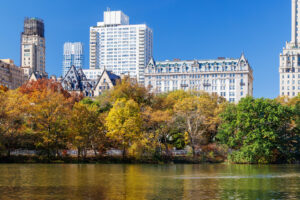
A century later, the geography has tightened, and the real estate stakes have reached into the stratosphere. Today’s 2.5-mile route is essentially a curated tour of Manhattan’s trophy assets. Stepping off at West 77th Street and Central Park West, the balloons immediately glide past prewar limestone cooperatives like The Dakota, The San Remo, and The Majestic, before passing 15 Central Park West, the Robert A.M. Stern-designed condominium where residences routinely trade north of $20 million.
In New York brokerage circles, a direct view of the parade route is treated as the ultimate seasonal amenity. Listing descriptions along Central Park West and Central Park South routinely tout front-row seats to the festivities, turning a bitter Thursday morning into a turnkey excuse to host a black-tie brunch in cashmere socks. At buildings like 220 Central Park South, where active listings have reached $87.5 million, residents look down on the procession as it makes its sharp turn toward Sixth Avenue. Down at street level, tourists camp out before dawn behind metal barricades, while fifty stories up, billionaires watch the same spectacle with heated floors and zero crowd control.
Once the parade turns south onto Avenue of the Americas, the real estate narrative shifts from ultra-luxury residential to institutional commercial power. The balloons float past a canyon of glass and steel towers that anchor billions of dollars in commercial mortgage-backed securities, including 1290 Avenue of the Americas, 1211 Avenue of the Americas, and the Bryant Park office corridor. Even in an era when Manhattan office landlords have fought tooth and nail to lure workers back to their desks, Thanksgiving morning delivers an unrivaled global broadcast backdrop that money simply cannot buy.
The irony of the entire spectacle sits waiting at the finish line on 34th Street. For decades, Macy’s has used the parade to cement its brand in the American psyche, yet on Wall Street, the retailer’s real estate has frequently been valued higher than its actual retail business. Analysts and activist investors have spent years dissecting the worth of the Herald Square flagship, with estimates for the building and its untapped air rights stretching well past the $1 billion mark.
In true New York fashion, the parade is a reminder that nothing in Manhattan is ever just about sentiment. The marching bands play, the confetti falls, and Santa Claus waves from his sleigh, all while gliding past a corridor of limestone, glass, and air rights that remains the true star of the show.