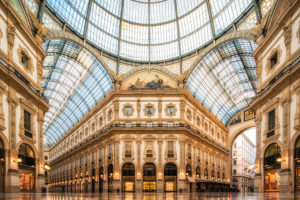
Start with a number: 29.5%. That is the share of Florentine property listings that qualify as prestige real estate, according to a new analysis by Gruppo Gabetti. No other major Italian city comes close. Milan reaches 24.7%. Naples, 23.3%. Rome, despite its scale and global profile, sits at just 12.8%. Florence is not merely Italy’s art capital. By this measure, it is also its most exclusive property market.
The numbers matter because they signal something structural, not cyclical. Florence hasn’t accidentally accumulated prestige listings. The city’s historic center is UNESCO-protected. Buildable land is essentially gone. New supply in the truest sense, genuine new construction within the city’s most desirable zones, is close to impossible. What enters the market is what already exists: medieval palazzos, Renaissance-era villas, 19th-century apartments with original frescoes and double-height ceilings. The supply constraint is permanent. Demand is not.
American buyers have been quietly paying attention for several years. The combination of a historically favorable dollar-to-euro exchange rate, Italy’s flat-tax regime for new residents (a fixed annual tax of €100,000 on foreign income, introduced in 2017), and a growing appetite for European lifestyle assets created the conditions for sustained U.S. interest. That interest accelerated post-pandemic as high-net-worth individuals reconsidered where and how they wanted to live.
What Are They Actually Buying?
Riccardo Di Loreto, Director for Tuscany and Campania at Santandrea Luxury Houses, describes the demand profile clearly: international buyers are targeting historic villas and fully renovated residences, with panoramic views and outdoor space at the top of the checklist. The average budget sits between 1 and 1.5 million euros. That bracket, roughly $1.1 to $1.65 million at current rates, buys something in Florence that it cannot buy in New York, London, or Paris.
The preferred locations break along two lines. First, the established core: the historic center and the southern hills, where addresses carry centuries of prestige. Second, and more telling for anyone reading market signals, two neighborhoods that have emerged as poles of contemporary luxury: San Niccolò and San Frediano. Both sit on the Oltrarno, Florence’s south bank. Both have, over the past decade, attracted a younger, design-conscious buyer willing to pay premium prices for properties that have been intelligently renovated rather than frozen in time.
This geographic diversification is significant. It means Florence’s prestige market is not a single, aging pocket of demand. It is spreading.
The Patience Premium
Italian luxury real estate rewards patient capital. Transactions in this segment routinely exceed twelve months from initial inquiry to closing. Price negotiations typically run between 10 and 20%. For buyers accustomed to the velocity of American markets, where competitive bidding and 30-day closings are common, this requires a genuine shift in approach.
The patience premium, however, has historically paid off. Italian luxury property values have appreciated roughly 18% over the past three years, even as higher interest rates created turbulence in other asset classes. The combination of supply constraint, international demand, and a currency that remains attractive to dollar-denominated buyers has provided a degree of stability that investors in more liquid markets often trade away without realizing it.
There is also a non-financial dimension that serious investors increasingly factor in. A restored Florentine palazzo is not simply an asset on a balance sheet. It is a seat at one of the oldest tables in Western civilization. For certain buyers, that carries weight that no yield calculation can fully capture.
The Two-Market Logic
What makes the Italy-U.S. dynamic particularly compelling right now is that it operates in both directions. American buyers are moving capital into Tuscany. Italian investors, particularly entrepreneurs and family offices navigating wealth succession, are increasingly allocating into New York and Miami. The U.S. market offers what Italy’s luxury segment does not: scale, liquidity, and a legal framework that facilitates faster execution.
Italian high-net-worth buyers are drawn to Manhattan’s trophy residential market and to Miami’s continued rise as a global wealth hub. Both cities offer asset classes, commercial real estate, branded residences, development-stage opportunities, that simply do not exist in Florence or Milan at equivalent scale. For an Italian family office looking to diversify geographically without abandoning the quality and exclusivity that defines their domestic holdings, the U.S. presents a logical expansion.
The two markets, once considered parallel, are increasingly complementary. Understanding how to operate in both simultaneously, navigating different legal systems, tax regimes, financing structures, and cultural expectations around negotiation and disclosure, has become a meaningful competitive advantage for investors who have done the work.
___
Few firms operate with genuine fluency across both markets. Columbus International Real Estate is one of them. Headquartered at Rockefeller Center in New York, with offices in Miami, Milan, and Florence, Columbus has built its practice around the precise transaction type this moment demands: sophisticated buyers and investors who need a single, trusted advisor on both sides of the Atlantic. The firm functions as a market observatory as much as a brokerage, tracking the Italy-U.S. real estate relationship with the kind of granular, on-the-ground intelligence that no database alone can provide. Whether the brief is guiding an Italian investor through their first U.S. acquisition or introducing an American buyer to the finest available properties in Tuscany, Columbus brings the expertise and the network to execute with precision. For inquiries:
info@columbusintl.com