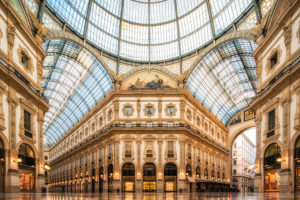
There’s a pattern worth watching in high-end real estate: when a city earns a place on the global event calendar, the market doesn’t just react, it resets. Milan went through this in 2015 with Expo. The city that emerged afterward was measurably different, not just in terms of square-meter prices, but in terms of who was buying, why, and from where. Now, with the 2026 Winter Olympics anchoring both Milan and Cortina d’Ampezzo on the world stage simultaneously, that reset is happening again. And this time, American capital is paying closer attention.
To understand why, you have to look past the ribbon-cutting optics and into the structural story underneath.
The Milan Playbook
Milan’s luxury residential market has spent the last decade quietly becoming one of Europe’s most compelling propositions for serious buyers. The neighborhoods that matter, Brera, the historic center, the Quadrilatero della Moda, offer something increasingly rare in major European cities: genuine scarcity without the overexposure that has dulled the luster of, say, London’s prime postcodes or Paris’s most tourist-saturated arrondissements.
Transactions above ten million euros are no longer headline events in Milan. They are, increasingly, routine. Properties moving above twenty million are closing with regularity. What’s driving that? Partly supply: there simply aren’t many piano nobile apartments in restored 18th-century palazzi, and no one is building more. Partly international demand: buyers from the Middle East, Northern Europe, and the United States have discovered that Milan punches above its weight in terms of cultural capital and below its weight in terms of price, at least compared to comparable assets in Paris or Monaco.
But the deeper driver is a shift in how global wealth thinks about real estate. The ultra-high-net-worth buyer in 2025 isn’t just buying a property. They’re buying a platform: a place to live, entertain, work, and access a lifestyle ecosystem that money can assemble but not manufacture from scratch. Milan offers that. A newly converted townhouse redesigned by an internationally recognized architecture firm, with a private wellness floor and a courtyard that muffles the city outside, isn’t a luxury purchase in the traditional sense. It’s an infrastructure decision.
Cortina’s Different Equation
Cortina d’Ampezzo operates on different logic, and that’s precisely what makes it interesting. Where Milan’s appeal is cosmopolitan and long-established, Cortina’s is more singular: there is no other place in the world quite like it. The Dolomites are a UNESCO World Heritage site. The valley is finite. And for decades, Cortina traded on its reputation as Italy’s most glamorous ski resort without particularly needing to modernize.
The Olympics changed the calculus. Not because a sporting event transforms a mountain town overnight, but because the infrastructure investment and global attention that follow an Olympic designation tend to be permanent. New roads, upgraded facilities, a fresh wave of international press coverage: these don’t disappear after the closing ceremony. They compound. Buyers who understand this dynamic, and many sophisticated ones do, are positioning now rather than waiting for the after-photo.
The product range in Cortina reflects a market in genuine transition. Historic barns converted into panoramic residences with floor-to-ceiling glass and radiant-heat floors. Chalets with staff quarters, private wellness suites, and direct ski access. Central apartments where the view from the living room is a wall of Dolomite rock face turning pink at dusk. What’s changed is the buyer profile. The market used to be almost exclusively Italian, old-money families from Milan and Rome who’d been coming for generations. Today, international buyers represent a growing share of demand, and they’re arriving with different expectations and, often, larger budgets.
Where the U.S. Fits In
Here’s the part of the story that rarely gets told clearly: the Italy-U.S. real estate corridor is more active, and more sophisticated, than most people realize.
American buyers have always had a romantic relationship with Italian property. What’s newer is the investment discipline they’re bringing to it. The weak euro relative to the dollar has made Italian assets meaningfully more affordable for dollar-denominated buyers over the past several years. A ten-million-euro property in Milan costs a buyer holding dollars considerably less than it did in 2019. That’s not a minor footnote; it’s a structural pricing advantage that informed buyers are actively factoring into their decisions.
The flow moves in both directions. Italian wealth, particularly from the entrepreneurial north, has been diversifying into U.S. real estate for years, with New York and Miami as preferred destinations. The reasons are familiar: dollar-denominated assets, portfolio diversification, lifestyle optionality, and in many cases, children studying or working in the States. What these buyers want isn’t a generic luxury apartment. They want informed guidance, cultural fluency, and a counterpart who understands both markets from the inside.
That’s a more specific need than most agencies are equipped to meet.
The Bridge That Actually Works
Columbus International Real Estate was built around exactly this dynamic. Headquartered at Rockefeller Center in New York, with offices in Miami, Milan, and Florence, the firm operates as a market observatory as much as a brokerage: tracking capital flows, developer pipelines, and buyer sentiment across both sides of the Atlantic in real time.
The specialty is the Italy-U.S. corridor. For American buyers approaching Milan or Cortina for the first time, that means access to inventory, context, and introductions that don’t come from a website search. For Italian investors entering New York or Miami, it means a team that already knows the market, speaks the language, and can navigate the structural differences between Italian and American real estate transactions without a learning curve at the client’s expense.
In a market defined by scarce product and high stakes, that kind of informed, dual-market presence isn’t a convenience. It’s the whole point.
For inquiries, contact Columbus International Real Estate at info@columbusintl.com