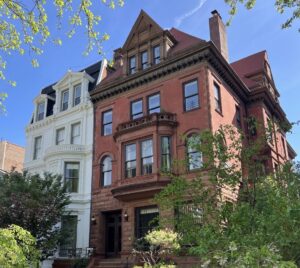
Daniel Craig and Rachel Weisz paid $6.75 million for a Cobble Hill townhouse in 2017. They just sold it for $11.8 million. A $5 million gain on a single property in eight years, through a pandemic and a mortgage rate shock that reshaped most of the American residential market. If you want to understand why sophisticated European capital keeps flowing into U.S. real estate, start here.
The sale of 22 Strong Place is interesting not because a famous couple cashed out “in the name of speculation,” but for what it confirms about the transformation underway in Brooklyn, the one that Cobble Hill and its surrounding neighborhoods have been quietly staging. These areas have become, in just five years, the most resilient segment of New York’s residential market. These are architecturally protected brownstone blocks, irreproducible by definition. You cannot build more of them. That scarcity, combined with proximity to Manhattan and an enclave quality that resists the transience of luxury towers, has generated extraordinary long-term performance. According to data from townhouse specialty brokerage Leslie J. Garfield, the average townhouse in Cobble Hill sold for $5.2 million in the first half of 2025, up 14 percent year-over-year. In February, a renovated home at 307 Hicks Street in Brooklyn Heights set a borough record, closing at nearly $15 million. The market isn’t slowing. It’s repricing.
Italian buyers, in particular, know how to read this kind of market. Because they have often navigated it themselves.
Consider what has happened to prime property in the historic center of Florence, along the Amalfi Coast, or in the hills above Lake Como. Values have risen between 18 and 22 percent over the past three years in Italy’s most sought-after markets, driven by the same fundamentals now reshaping Brooklyn: limited supply, architectural irreplaceability, and a buyer pool that has gone global. The flat-tax regime for new residents has drawn capital from the United States, the United Kingdom, and the Middle East. That capital didn’t simply renovate farmhouses. It reset Italian sellers’ expectations and compressed yields to the point where the more opportunity-minded Italian investor is now looking beyond their own borders.
New York is a natural destination. The reasons are partly rational, partly cultural. Rational: dollar-denominated assets have historically offered a hedge against euro volatility, American title is clean, and the legal structure of ownership is familiar to anyone who has worked with an international estate attorney. Cultural: New York and Italy’s major cities share a particular relationship with urban density. The pleasure of walking to a market, the premium placed on historic fabric, the idea that a building can carry a story within its walls – all of this resonates. An Italian buyer standing inside a Cobble Hill brownstone doesn’t feel disoriented. The bones are different, but the logic is the same.
What has changed over the past two years is the level of sophistication on both sides of the transaction. We are no longer in the era of the Italian industrialist buying a pied-à-terre near Central Park as a holiday gesture. Today’s Italian buyers run yield analyses, study sub-market dynamics, and think in terms of portfolio construction. They want to understand the difference between a co-op and a condominium, why certain Brooklyn zip codes have outperformed the Upper East Side over a ten-year horizon, and what the SoHo rezoning actually means for residential values. They arrive with questions that would have surprised brokers a decade ago.
American interest in Italian real estate has followed a parallel arc. After the pandemic, a significant cohort of high-net-worth Americans reconsidered what they wanted from a second home. Tuscany and the lakes had always attracted buyers, but the market has deepened. Interest now extends to Puglia, to the regenerating neighborhoods of Palermo, to Venetian properties that generate rental income tied to cultural tourism. Americans who bought in Florence in 2019 for 600,000 euros are sitting on assets that have appreciated considerably – in some cases by 30 percent or more in local currency terms, before accounting for any favorable exchange rate movement. The conversation has shifted from “Italy is beautiful” to “Italy is a legitimate asset class.”
The Craig-Weisz sale is a useful data point in this larger story for one precise reason: it illustrates the premium that accumulates over time on an irreplaceable, carefully maintained property. The couple had purchased with approved renovation plans and a landmark designation. They owned the adjacent property and sold it separately. They managed the asset like professionals, not like people who happened to own a famous address. That discipline, applied in a supply-constrained market, is exactly the framework that sophisticated Italian buyers bring with them when they approach American real estate. And it is precisely the framework that discerning American buyers should apply when they look at Italy.
The transatlantic luxury market in 2026 is not about trophy hunting. It is about identifying properties, in each country, that share the characteristics of 22 Strong Place: architecturally distinctive, legally sound, in markets where new supply cannot compete with the existing stock. Those are the properties – in Brooklyn and Bologna, in Miami and Milan – that have built returns consistently over time.
olumbus International Real Estate operates from Rockefeller Center in New York, with offices in Miami, Milan, and Florence. Our brokers have spent years on both sides of the Atlantic, connecting Italian buyers with the American market and American buyers with Italian opportunities. They follow this market closely, they know the key players, and they offer their clients the kind of guidance that only comes from genuine presence in both places. If this article has raised any questions or sparked any curiosity, our brokers are exactly the right people to turn to: info@columbusintl.com.