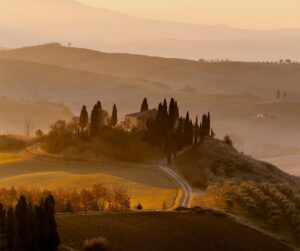
Forty-four hectares of Tuscan countryside. Ninety rooms. A private church. An olive grove that has been producing oil for centuries. And a price that nobody will confirm publicly.
The medieval borgo of Buriano, perched above the Valdicecina valley near Volterra, has officially come to market. The transaction is private, the terms undisclosed. But the asset itself tells the story clearly enough: this is roughly 11,000 square meters of historic built fabric, a working agricultural estate, a small hotel, and one of the most arresting views in central Tuscany. It is, by any serious measure, one of the most complex and compelling real estate opportunities in Italy right now.
For American buyers with capital looking abroad, it’s also a case study in exactly what the Italian market is offering that the U.S. market simply cannot.
Why the Timing Is Not Accidental
Italy’s luxury property market has appreciated roughly 18% over the past three years, according to industry data tracked across prime Tuscan and coastal markets. That number understates the story. In villages and historic centers with genuine scarcity, where no new supply can be built because the buildings themselves are the supply, values have moved faster. Buriano is a pure expression of this logic. There is one borgo. There will always be one borgo.
American buyers understand scarcity pricing. What many are still learning is that Italian assets carry a different kind of scarcity: not just limited inventory, but limited permission. Heritage restrictions, local planning laws, and historical protection designations mean that even a well-capitalized investor cannot replicate what already exists. You can build a luxury hotel in Miami. You cannot build a 12th-century fortified settlement in Tuscany.
That asymmetry has not been lost on the market.
What Buriano Actually Is
Founded in the early medieval period as a Saracini feudal holding, Buriano’s hilltop position was originally its greatest asset. Elevation meant defense. It also, eventually, meant isolation, and the borgo experienced the same demographic retreat that emptied dozens of similar settlements across central Italy through the 20th century. What remains is architecturally intact in ways that actively developed properties rarely are.
The central villa runs to 4,500 square meters across 90 rooms, with historic cellars that would command serious attention from any number of wine-focused hospitality concepts. Three additional historic structures await restoration. The church is private. A farmhouse anchors the agricultural portion of the land, which divides between a productive olive grove and a managed hunting reserve.
An 18-room hotel with restaurant already operates on the property, which is relevant for two reasons: it establishes existing use rights, and it proves the site can function as a hospitality business while broader development plans mature. That is not a trivial point. Anyone who has navigated Italian planning processes knows that having a functioning permitted use is worth years of approval timelines.
The Strategic Picture
Buriano sits 15 kilometers from Volterra, one of the best-preserved Etruscan and medieval hill towns in Italy, and a short drive from Bolgheri, the appellation responsible for Super Tuscans including Sassicaia. The Cecina coast is nearby. The positioning puts this property at the intersection of cultural tourism, wine tourism, and coastal access, the three drivers that have made this corridor of Tuscany increasingly attractive to international buyers over the past decade.
The question every serious investor will ask is not whether this asset has value. It obviously does. The question is which development model unlocks that value most effectively under Italian heritage law, which is both protective of historic fabric and, when navigated correctly, supportive of sympathetic adaptive reuse.
The options the market is considering include a private estate consolidation, a luxury borgo-hotel in the tradition that Castello di Casole and Rosewood Castiglion del Bosco have proven at scale, or a members’ club model that has found renewed interest among UHNW buyers seeking curated European bases outside the traditional Mediterranean hotspots.
The Larger Pattern
Buriano is singular, but it is not isolated. It reflects a broader dynamic in which Italian owners of generational assets, often families managing properties that have become too large and complex to maintain privately, are now meeting a global buyer pool that has both the capital and the appetite for exactly this kind of opportunity.
The Italy-U.S. corridor has become one of the more active cross-border luxury property channels. Dollar strength relative to the euro over the past two years has compressed entry costs for American buyers. Simultaneously, Italian developers and private sellers have grown more sophisticated about international marketing, recognizing that the domestic buyer pool alone cannot absorb the premium end of the market.
What remains is execution: finding the right transaction structure, understanding heritage financing vehicles, navigating the approvals process, and matching the right buyer profile to an asset that is genuinely unlike anything available at comparable scale in the U.S. market.
Columbus International Real Estate has spent years building the specific infrastructure this kind of cross-Atlantic transaction requires. Headquartered at Rockefeller Center in New York with offices in Miami, Milan, and Florence, the firm functions as something closer to a market observatory than a traditional agency. It tracks the Italy-U.S. corridor in both directions: guiding Italian investors through American markets while introducing American and international buyers to assets like Buriano that rarely surface through conventional channels. For opportunities of this complexity, having advisors who operate natively on both sides of the Atlantic is not a convenience; it is the difference between a transaction that closes and one that stalls. Reach the team at info@columbusintl.com.