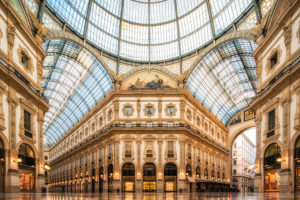
Milan has never needed an introduction. The city moves at a different pace than the rest of Italy, sharper and more mercantile, with a real estate market that reflects its identity: premium-priced, internationally connected, and stubbornly resistant to the volatility that has rattled other European capitals. Its #2 ranking in the Barnes City Index 2026, part of the firm’s closely-watched Global Property Handbook, is not a surprise. It is confirmation of something sophisticated buyers have known for a while.
PROPERTIES FOR SALE IN MILAN
What is new is what is happening 570 kilometers to the south.
Rome climbed from ninth to eighth in the same index this year, a modest numerical shift that tells a bigger story. The city that spent much of the past decade fighting its own reputation for dysfunction is quietly becoming one of the most compelling value plays in European luxury real estate. Average prices in Rome’s historic center still sit well below comparable square footage in London or Paris. In some of the most coveted addresses in Paris’s 7th arrondissement, buyers pay north of €20,000 per square meter. In Rome’s Tridente, where palazzi line streets that have barely changed since the 18th century, that same budget commands considerably more. The gap is closing, but it has not closed.
Understanding why requires a look beyond market data.
The Milanese Benchmark
Milan functions, in many ways, as the Italian real estate market’s north star. Its prices are the highest in the country, its buyers the most international, and its commercial sector the most sophisticated. For American investors navigating Italy for the first time, Milan is often the first point of entry: familiar in its rhythms, globally connected, and anchored by a financial and fashion industry that sustains demand regardless of macroeconomic headwinds.
The numbers back this up. Luxury residential supply in Milan remains tight, particularly in the historic core and the recently transformed districts around Porta Nuova and CityLife. Developers who secured positions there five or six years ago have watched values appreciate at a rate that would have seemed optimistic at the time. Those who waited are now competing for a significantly smaller pool of product.
This is the Milan premium. It is real, and it is not going away.
Rome’s Structural Shift
What makes Rome’s trajectory worth examining is that it is not being driven by a single catalyst. Barnes CEO for Rome, Giovanni Gargano, described it in straightforward terms: the city has seen meaningful improvements in infrastructure, public spaces, cleanliness, and safety. These are not glamorous metrics, but in real estate, they are the ones that sustain long-term price appreciation. International buyers do not return to markets where the fundamentals are uncertain.
Rome is also experiencing a wave of luxury hotel development that speaks directly to investor confidence. The city currently ranks second worldwide for new high-end hotel openings, a figure that carries weight. Institutional hospitality groups do not commit capital at that scale unless they believe the underlying market supports it. The same logic that makes a luxury hotelier choose Rome over another European capital applies to a private buyer evaluating a pied-à-terre or a second home.
The most active residential neighborhoods follow a predictable hierarchy. The Tridente remains the prestige address, with prices reaching €15,000 per square meter and occasionally exceeding it. Pinciano and Parioli offer a more livable proposition at €8,000 to €9,000, favored by buyers who want the elegance without the tourist foot traffic. Prati and Flaminio attract those who want proximity to the historic center without paying historic-center prices. And then there is Monteverde Vecchio, a quieter choice, characterized by liberty-style villas and the kind of residential calm that is increasingly rare in any major European city.
Where the American Buyer Fits
The American appetite for Italian property has always existed, but it has sharpened noticeably in recent years. Part of this is currency-driven: the euro-dollar relationship has, in certain periods, made Italian real estate measurably cheaper for dollar-denominated buyers than the headline prices suggest. Part of it is structural: the post-pandemic normalization of remote work removed the friction that once made a prolonged stay in Milan or a semi-permanent life in Rome feel impractical.
The Barnes report identifies a broader phenomenon at work as well. Cities like Como, Venice, and Palm Beach, which once functioned primarily as seasonal destinations, are transforming into permanent residential markets. The buyers driving this shift are not retirees. They are working professionals, business owners, and investors who have concluded that geography is no longer a constraint on their professional lives. Italy, with its combination of aesthetic quality, relative affordability compared to northern European capitals, and improving urban infrastructure, sits squarely in their consideration set.
For Italian investors moving in the opposite direction, the American market, particularly New York and Miami, continues to offer something Italy cannot fully replicate: scale, liquidity, and the kind of asset velocity that suits a certain type of portfolio strategy. The interest runs both ways, and the most sophisticated players understand that Milan and Manhattan are not competing propositions. They are complementary ones.
Columbus International Real Estate operates from Rockefeller Center in New York, with offices in Miami, Milan, near Piazza Duomo, and Florence. The firm works both sides of this investment relationship: guiding Italian clients through the complexities of the American market, and introducing American buyers to the finest residential opportunities across Italy. It functions as a market observatory as much as an agency, tracking pricing, inventory, and demand signals across the Atlantic with the kind of granularity that only comes from being genuinely present in both markets. For buyers and investors who want analysis before they want a sales pitch, it is a useful place to start: info@columbusintl.com