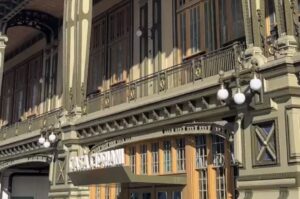
La Piadineria, Europe’s largest piadina chain, chose the Flatiron District for its U.S. debut. The address says everything about the brand’s ambitions.
When Italy’s La Piadineria went looking for its first American address, the company didn’t land in a food hall, a suburban strip mall, or a tourist-heavy corner of Midtown. It chose 18 E 23rd Street, a stone’s throw from the iconic triangular skyscraper that gave the Flatiron District its name and one of the most strategically loaded ZIP codes in New York commercial real estate.
The location is no accident. The Flatiron District has evolved over the past decade into a destination neighborhood that threads the needle between Silicon Alley’s tech-forward workforce, a dense residential base, and some of the city’s most consistently foot-trafficked retail corridors. For an international fast-casual brand looking to signal quality, scalability, and urban credibility in a single lease signing, it’s hard to imagine a stronger statement.
“The opening marks the company’s official entry into the American market,” the company said, describing the move as bringing its model, already deeply embedded across Italy, overseas for the first time outside of Europe.
A 530-Unit Chain With Something To Prove In America
La Piadineria isn’t a startup making a splash. Founded in 1994 in northern Italy, the brand has grown into the country’s largest fast-casual operator, with more than 530 locations running from the Italian Alps to Sicily. In 2025 alone, it opened more than 80 new restaurants, a clip that puts it among the fastest-growing food chains on the continent.
The brand’s product is the piadina, a flatbread with deep roots in the Romagna region of Italy, filled with a rotating cast of fresh ingredients. Every dough disk is produced at La Piadineria’s dedicated facility in Montirone, in the northern province of Brescia, and distributed to locations under a proprietary recipe unchanged since the company’s founding. The New York menu features more than 30 variations. The first one ever served at the Flatiron location was “Giulia,” a riff on the chain’s best-selling Italian piadina built on crudo, squacquerone cheese, and rocket, adapted just enough for the American palate.
Since 2024, La Piadineria has operated under CVC Capital Partners, the global private equity firm with a broad consumer brand portfolio across Europe and beyond. That backing gives the chain not just capital, but the operational infrastructure to execute the kind of multi-market international expansion its CEO is now describing publicly.
The Real Estate Play: Why Flatiron?
The Flatiron District takes its name from the landmarked 1902 skyscraper sitting at the convergence of Fifth Avenue, Broadway, and 23rd Street, and it occupies a genuinely distinctive position in New York’s commercial landscape. Sandwiched between Chelsea, Gramercy, and NoMad, the neighborhood pulls lunch-hour foot traffic from a dense concentration of tech firms, ad agencies, and financial services offices, then draws an entirely different crowd of retail and dining visitors in the evenings and on weekends. It is one of the few pockets of Manhattan where a restaurant concept gets tested by multiple consumer profiles every single day.
For a fast-casual brand entering the U.S. market, that’s invaluable. The Flatiron consumer is simultaneously trend-conscious and value-aware, willing to pay a premium for quality but conditioned by years of serious competition in the neighborhood’s food scene to expect something genuinely differentiated. This is not a market that rewards novelty alone, and the brands that have put down roots here know it.
La Piadineria is betting that the piadina’s combination of portability, customization, and authentic Italian provenance is enough to carve out a durable niche. The early signals have been encouraging. The New York Times covered the opening, a form of editorial validation that carries real weight in the city’s notoriously crowded restaurant media environment.
A Structured Industrial Project, Not A Symbol
CEO Roberto Longo has been deliberate about framing the New York opening not as a brand-building exercise but as the first move in a long-term expansion strategy.
“The American market is highly competitive but receptive to quality formats, scalable and with a strong identity,” Longo said. “Our entry into the United States is not a symbolic operation, but the start of a structured industrial project.”
That language is worth paying attention to. In real estate and franchise development terms, “structured industrial project” signals a pipeline: site selection criteria, unit economics modeling, and a replication strategy built to travel across multiple urban markets. La Piadineria’s international playbook, launched in France in 2017, provides the proof of concept. The French expansion showed that the brand’s core model, centralized production paired with standardized product and local market adaptation, could survive the translation from Italian consumer culture into a foreign one.
The U.S. presents a different order of complexity. Real estate costs, labor markets, and consumer expectations in American cities diverge sharply from European norms, and anyone who has watched a European food concept stumble here knows the gap is easy to underestimate. What’s notable about La Piadineria’s approach is the pacing: a single deliberate flagship opening before any announced expansion, in a neighborhood specifically chosen to do the work of market validation.
What Comes Next
La Piadineria has not announced specific additional U.S. locations, but Longo’s description of a “broader project of expansion” built around a “flexible, replicable business model capable of adapting to different urban contexts” points clearly toward a rollout targeting other dense, high-income urban cores, the same neighborhoods where premium fast-casual concepts like Sweetgreen and Dig have already proven the category’s staying power.
The real test, as with any European food brand crossing the Atlantic, is whether the product’s authenticity can scale without dilution, and whether the real estate strategy can keep pace with a market where prime urban retail space is both expensive and fiercely contested. Those answers won’t come from one location in the Flatiron District.
Source: Il Sole 24 Ore
La Piadineria’s U.S. flagship is located at 18 E 23rd Street, New York, NY, in the Flatiron District.