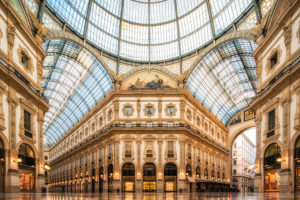
When the UK dismantled its two-hundred-year-old non-domiciled tax regime in 2025, the consequences were immediate. What had been a slow drift of wealthy residents out of London became a visible reallocation of people and capital. The more interesting development was the destination of that outflow. In private-wealth circles, the phrase svuota Londra—“empty London”—began circulating with a mix of irony and accuracy. Milan, long regarded as a functional but unremarkable business centre, emerged as the main beneficiary of a realignment few had predicted a decade ago.
Italy’s position in this race was not accidental. Real estate investment reached €5.2 billion in the first half of 2025, a year-on-year increase of more than fifty percent, with international buyers responsible for roughly sixty percent of total volume. This is one of the highest concentrations in Europe. Recent market research indicates that much of this capital is now channelling through Milan, where both institutional and private investors have shifted from cautious observation to active deployment.
This redirection of wealth cannot be explained by tax efficiency alone. Italy’s flat-tax regime, introduced in 2017 and refined in subsequent years, offers predictability at a moment when many Western countries have moved in the opposite direction. Qualifying residents can pay a fixed annual amount on foreign-sourced income for up to fifteen years. Family members can benefit from a reduced levy, and participants are exempt from wealth and inheritance taxation within certain parameters. The appeal lies not only in the structure itself but in the long horizon it offers for financial planning, family strategy and cross-border asset management.
The effect of this framework intensified just as Milan completed a decade-long upgrade of its physical and cultural infrastructure. A few years ago, the city was still considered undervalued. Inflation-adjusted housing prices sat nearly thirty percent below their 2007 levels, a point highlighted in earlier assessments of global financial centres. Urban redevelopment, particularly in districts such as Porta Nuova and CityLife, helped change that perception. Between 2017 and 2025, residential prices in Milan rose almost fifty percent, well ahead of the modest gains recorded in other major Italian cities. Updated Milan analyses show a growing scarcity of high-quality stock. This scarcity suggests that today’s pricing reflects long-delayed realignment rather than a speculative surge.
The commercial real estate market reflects similar strength. Hospitality investment reached €1.5 billion in the first half of 2025. Retail volumes more than doubled. Logistics and residential sectors also saw notable increases, supported by the rising influence of private-wealth capital. An industry overview notes that private investors allocated roughly €660 million in the first quarter alone, accounting for nearly a quarter of all national investment.
What sets Milan apart from other European wealth destinations is the combination of financial depth and lifestyle infrastructure. Switzerland offers established financial services but faces possible changes to inheritance taxation. Monaco provides favourable taxation but limited space and institutional breadth. Dubai attracts globally mobile entrepreneurs yet lacks proximity to European business hubs. Milan occupies a unique middle position. It hosts Italy’s stock exchange, maintains dense networks of legal and financial advisors, and has expanded its cultural and culinary footprint. The reduction of VAT on art acquisitions to one of the lowest levels in Europe has encouraged additional gallery openings and reinforced the city’s cultural standing.
Lifestyle also plays a significant role in modern wealth migration. High-net-worth families increasingly look for cities that provide walkability, international schooling, efficient public transport and access to both alpine and coastal destinations. Milan satisfies these expectations while remaining less than two hours from London by air. The city’s three international airports, its expanding metro system and the infrastructure created for the 2026 Winter Olympics strengthen its appeal. Even the decision to convert the Olympic Village into subsidised student housing reflects an understanding that a successful city must balance luxury with affordability.
There are challenges. Gentrification has accelerated in neighbourhoods that once housed working-class communities. Property costs and condominium fees have increased sharply in some districts. A wide-ranging investigation into irregularities in planning permissions for luxury developments has highlighted the strains that accompany rapid transformation. Critics warn that Milan risks orienting itself too heavily toward global wealth, which could undermine the social and economic diversity that supports long-term stability. These concerns are common in cities undergoing abrupt reinvestment, and Milan is no exception.
Interest in Italian real estate extends far beyond Milan. Multi-year studies of foreign search behaviour point to strong demand from Germany, Switzerland, the United States, France and the United Kingdom. Coastal and island regions such as Sardinia and Sicily continue to attract international buyers, while the northern lakes maintain their status as lifestyle-driven investment destinations. The shift in preference from compact apartments to higher-specification, centrally located homes indicates a broader recalibration of what global buyers consider defensible long-term assets.
Italy’s broader macroeconomic backdrop remains modest. GDP growth is expected to remain under one percent in 2025, and the country’s public-debt levels continue to concern European policymakers. Bureaucracy remains a real burden for newcomers. Milan’s increasing reliance on international capital introduces exposure to sentiment shifts. Yet the structural forces driving today’s inflows, including the UK’s reversal of long-standing policy and the long-term stability of Italy’s fiscal framework, suggest that this is not a short-lived episode. It is a structural reordering of Europe’s wealth geography.
The larger lesson is that tax policy is no longer a technical matter. It has become a tool of strategic competition. By signalling openness to internationally mobile capital and pairing tax clarity with urban reinvestment, Italy has positioned itself as Europe’s most compelling alternative to traditional wealth hubs. Milan’s evolution, from undervalued outlier to strategic base for global families, illustrates how policy, economics and city building can reinforce one another.
Whether this position endures will depend on political continuity and Milan’s ability to manage growth without eroding social balance. For now, the direction is clear. Milan is no longer chasing Europe’s financial centres. It is competing with them, and increasingly, it is ahead.
Richard Tayar is the founder of Columbus International, an international real estate firm bridging markets between the United States and Italy, with focus on New York, Milan, Tuscany, and Miami.